A breach of project sustainability requirements may result in an obligation to repay part or all of the funding. The extent of that risk depends, however, on which obligation was breached, when the relevant event occurred and what impact it had on the project results.
Completion of project implementation and payment of the final instalment of funding do not mean that the relationship between the funding recipient and the funding institution has ended. In most projects, the completion of the implementation stage is followed by a sustainability period during which the business is required to maintain specified project results, the manner in which the investment is used, or other elements identified in the project documentation. Failure to comply with these obligations may expose the funding recipient to an allegation of breach of project sustainability requirements. Problems arise in particular where the funding recipient’s business circumstances change during this period and, as a result, its operations are reduced or an asset is to be sold. In such cases, the revenues originally projected for the project may no longer be achieved, or continued maintenance of a particular solution may cease to be commercially justified.
The occurrence of such a change does not in itself mean that the project sustainability requirements have been breached. It is first necessary to determine which obligation had to be maintained after completion of the project and whether the event that occurred actually falls within the circumstances giving rise to repayment of funding. Only then can the second question be addressed: whether any repayment should cover the entire amount of funding, only part of it, or an amount corresponding to the period during which the sustainability requirements were not met.
The sustainability period is not a continuation of project implementation
One source of difficulty is treating the sustainability period as if the project simply remained in the implementation phase for several more years. In fact, these are two separate stages, governed by different obligations and events. During project implementation, the business carries out the planned activities, incurs expenditure and seeks to achieve the expected results. Once implementation has been completed, the focus is generally on maintaining what has already been achieved, within the scope required by the applicable rules and project documentation.
This distinction was expressly accepted by the Supreme Administrative Court in its judgment of 25 June 2026. Although the case concerned the limitation period applicable to an irregularity identified during project implementation, the Court rejected the view that an irregularity arising during project implementation would, for that reason alone, continue until the end of the project sustainability period. The Court indicated that the sustainability period serves, as a rule, to maintain the project results rather than to continue project implementation.
The significance of this position goes beyond the issue of limitation periods. Where a funding institution alleges a breach after project implementation has ended, it is necessary to identify precisely what the alleged breach concerns. A defective contractor selection made several years earlier must be assessed differently from the sale of subsidised infrastructure during the sustainability period, and differently again from the failure to perform an obligation that, under the funding agreement, was specifically intended to be carried out after implementation had ended. The fact that all of these issues relate to the same project does not make them a single continuing breach.
A similar distinction between the two periods can be seen in the judgment of the Voivodeship Administrative Court in Poznań of 5 March 2026. The case concerned the assessment stage of an application for funding for an R&D project. The Court accepted an assessment requiring the business to demonstrate who would carry on the activity after completion of the R&D work and what resources would be used for that purpose. Merely ensuring competent personnel for the project implementation period was not sufficient where the call documentation required the applicant to demonstrate organisational and financial capacity also for the sustainability period. The Court expressly noted that the project implementation period does not coincide with the project sustainability period.
This shows that project sustainability is not an issue that becomes relevant only after project implementation has ended. In some calls for applications, the way in which project results are to be maintained is assessed already when funding is awarded, and commitments made in the funding application may later determine the scope of the funding recipient’s obligations.
What does a breach of project sustainability requirements actually mean?
For projects implemented under the 2021–2027 financial perspective, the basic rule is set out in Article 65 of Regulation (EU) 2021/1060 of the European Parliament and of the Council. For operations comprising investment in infrastructure or productive investment, the provision establishes a five-year period from the date of the final payment to the funding recipient or, where State aid rules apply, for the period laid down in those rules. For investments or jobs created by SMEs, Member States may reduce that period to three years.
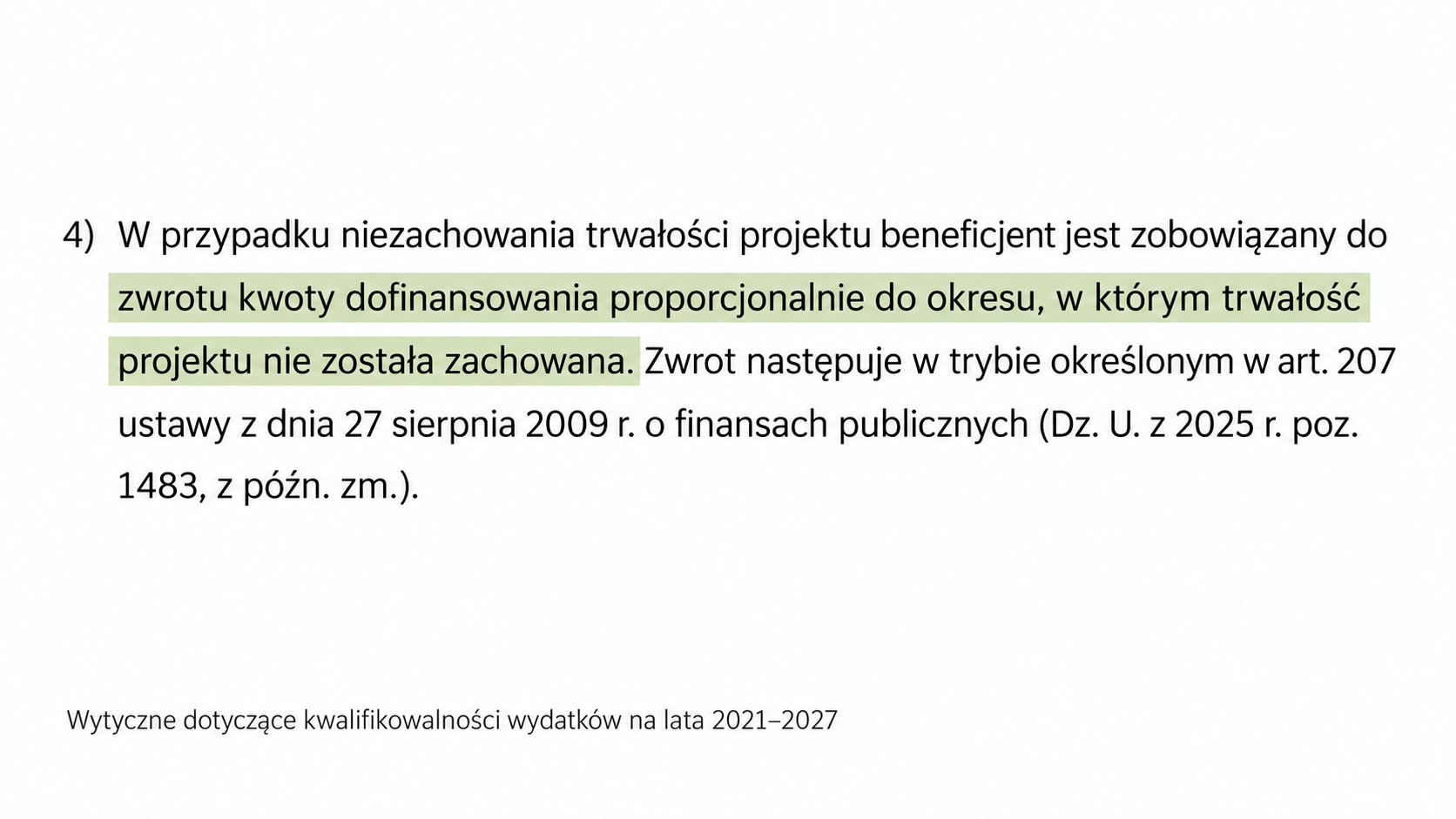
These rules are further developed in the Guidelines on the eligibility of expenditure for 2021–2027. The Guidelines state that the sustainability period is calculated from the date of the final payment to the funding recipient. Depending on how the project is settled, that date may be the date on which the funding institution debits its account when transferring funds, or the date on which the final payment application is approved. Importantly from the perspective of financial consequences, where sustainability requirements are not complied with, the funding recipient is required to repay funding proportionately to the period during which project sustainability was not maintained. The Guidelines also specify the circumstances that may constitute a breach of sustainability requirements, corresponding to the structure of Article 65 of Regulation 2021/1060.
Article 65 links the repayment obligation to specific events: the cessation or relocation of a productive activity outside the relevant NUTS 2 region, a change in ownership of an item of infrastructure that gives a firm or public body an undue advantage, or a substantial change affecting the nature, objectives or implementation conditions of the operation which would result in undermining its original objectives.
This is particularly important when assessing events such as the sale of equipment, a restructuring of the business, or a change in the way infrastructure is used (see also: Does the sale of a company require repayment of funding?). A change in ownership structure alone does not automatically satisfy the condition set out in Article 65(1)(b) of the Regulation. The provision links the change in ownership with the obtaining of an undue advantage by a firm or public body. Similarly, a change in the business model must be assessed in terms of its actual impact on the nature or objectives of the operation, rather than merely by noting that the circumstances after completion of the project differ from those described several years earlier in the funding application.
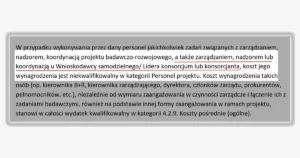
At the same time, Article 65 does not exhaust all obligations that may apply to a business after project implementation has been completed. The funding agreement, call documentation and rules of the relevant programme may impose obligations concerning the maintenance of specific results, continuation of business activities, the use or disposal of intellectual property rights, or the provision of information during the monitoring period. Therefore, where a funding institution demands repayment of funding, its mere reference to a “breach of project sustainability requirements” does not yet explain the legal basis for the repayment claim.
Achieving project indicators does not always conclude the assessment of the project
Achievement of project indicators is sometimes treated by the funding recipient as confirmation that the project-related obligations have been fulfilled. However, the indicators themselves do not always exhaust the substance of the obligations arising from the funding agreement and the application for funding. This factual situation was examined by the Supreme Administrative Court in its judgment of 21 July 2026.
Although the funding recipient argued that it had prepared the required documentation and made the necessary filings, and had therefore achieved the prescribed output and result indicators, the authorities and the courts focused on the broader content of the project documentation. In their view, that documentation showed that the funded activities were intended to lead to obtaining international protection for the invention. The Supreme Administrative Court held that, in this case, the indicators served to verify achievement of the project objective, but did not themselves exhaust the substance of the funding recipient’s obligation. Importantly, the broader objective was not constructed only once the dispute had arisen, but was derived from the funding application and the funding agreement.
Accordingly, where a business has formally achieved the specified indicators but, several years later, the funding institution concludes that the intended project outcome was nevertheless not achieved, it is necessary to determine the relationship between three elements: the indicator, the project objective and the specific obligation arising from the project documentation. Without distinguishing between those elements, it is difficult to determine correctly what obligation was actually breached.
A breach of project sustainability requirements does not automatically require repayment of the entire amount of funding
Once a breach has been established, the next step is to determine its financial consequences, which depend on the legal basis for the repayment obligation.
Under the current financial perspective, Article 65 of Regulation 2021/1060 expressly provides that repayment resulting from a breach covered by that provision is to be made in proportion to the period of non-compliance. The structure of the provision therefore excludes the assumption that every breach of project sustainability requirements requires repayment of the entire amount of funding, regardless of when the breach occurred or how long it lasted.
A good example is again the case decided on 22 July 2026, which the Supreme Administrative Court examined under the rules applicable to the previous financial perspective. The funding recipient argued that partial performance of the required activities and achievement of certain indicators should result in a reduction of the amount to be repaid. The Supreme Administrative Court did not, however, accept any automatic relationship between the degree to which the indicators had been achieved and the percentage of funding that the funding recipient was entitled to retain. The Court indicated that the assessment of proportionality must take into account the nature of the irregularity, its impact on project implementation and the significance of the breached obligation for achievement of the project objective.
This distinction is important. The argument that “we completed 80% of the project, so at most 20% of the funding can be repaid” does not follow automatically from the principle of proportionality. At the same time, it would also go too far to assume that any breach identified during the sustainability period justifies repayment of 100% of the funding. The amount to be repaid must follow from the provision applicable to the particular breach and from which element of the funded project was actually affected by it. Only then can it be determined whether the appropriate mechanism is proportionality by reference to the period of non-compliance, an assessment of the seriousness of the irregularity, a contractual provision relating to a specific indicator, or another settlement mechanism.
Post-project obligations may still determine the right to retain funding
A separate issue arises in relation to reports and declarations submitted after project implementation has already been completed. In this context, it is worth referring to the judgment of the Court of Justice of the European Union of 14 October 2021.
The case concerned liability arising from the submission of incorrect information about compliance with obligations during the sustainability period. The Court held that the protection of the European Union’s financial interests also covers situations in which inaccurate declarations are intended to create the appearance of compliance with obligations that continue after project implementation has been completed. What mattered was that compliance with those obligations was a condition for retaining funding previously received. The Court also made clear that it was irrelevant that the activities carried out during the sustainability period were financed from the funding recipient’s own resources.
The scope of that judgment should be approached with caution, because the Court was dealing with an issue of fraud rather than every type of irregularity that may be identified in proceedings concerning repayment of funding. The judgment nevertheless highlights an important point for funding recipients: completion of the funded phase does not sever later obligations arising from the support already received where, under the funding conditions, compliance with those obligations determines the recipient’s right to retain the funding.
Consequently, before submitting a further sustainability report, it is worth determining whether the report merely describes the current status of the project or also contains information from which the funding institution may conclude that one of the funding recipient’s earlier obligations has not been fulfilled.
In practice, a problem that emerges during the sustainability period should not be reduced to the question of how it is described in the next report. If the way in which an investment is used has changed, an expected result is not being achieved, an asset is to be sold, or continued compliance with an obligation has become impossible, the first issue is the legal characterisation of that event. Only then can the scope of information that should be provided to the funding institution be properly determined.
What does project sustainability mean for a business after the investment has been completed?
The sustainability period is usually the stage at which the project begins to operate under normal business conditions. Prices, markets, technology, staffing structures and contractors change, and sometimes the business model itself changes as well. Yet some decisions made by the business must still be assessed in light of the commitments made in the funding application. This does not mean that the business must remain in exactly the same state for three or five years after project implementation has been completed. What matters is whether a planned change in the business affects the conditions on which the funding was granted.
The sale of equipment purchased as part of the project, relocation of the business, a corporate reorganisation, or a reduction in a particular type of production may have very different implications for project sustainability. What matters may be not only the disposal of the asset itself, but also what happens to the project after the transaction. A situation in which the business disposes of an asset and ceases the supported activity is different from one in which the equipment is replaced, the project results continue to be used, and the investment objectives remain preserved. The disposal of intellectual property rights or technology developed within the project may require a separate assessment, as the provisions governing the use and disposal of project results will also be relevant.
Particularly difficult cases arise where a project has in fact been implemented and remains operational, but its economic performance differs from the assumptions made several years earlier in the funding application. The mere fact that a product sells less well than projected in the business plan does not in itself answer the question whether project sustainability has been maintained. A revenue forecast used to demonstrate the economic viability of the investment must be distinguished from a result indicator that the funding recipient was required to achieve, and from an obligation to maintain a particular project outcome for a specified period. Only once it has been established which of these situations is involved can the consequences of failing to achieve the expected results be properly assessed.
The sustainability period does not therefore freeze a business in place for three or five years, but certain business decisions may still affect its right to retain funding. This applies in particular to changes involving assets financed under the project, the way in which project results are used, the location of the business, intellectual property rights, or the continuation of activities that the funding recipient committed to in the funding application. A similar assessment is required where the project itself continues to operate but does not achieve the expected scale of sales or commercialisation. In such cases, the issue is not the change itself, but its impact on a specific obligation that continues to bind the funding recipient during the sustainability period.
If, during the sustainability period, the sale of a project asset or project result is planned, the way the business operates is to be changed, or difficulties arise in achieving the expected outcomes, those changes should be assessed before they are implemented or before information is submitted to the funding institution. The Law Firm supports funding recipients, among other things, in matters concerning project sustainability, project indicators, project controls and repayment of funding.