
The project has been settled, the funds have been paid and a project control carried out several years ago raised no concerns. Nevertheless, the institution returns to the project and challenges the way expenditure was documented, the achievement of project indicators or whether the project was implemented in accordance with the funding application. A project control becomes closely linked to repayment of funding only when the institution’s findings indicate a breach that may affect the eligibility of expenditure. It is usually at this stage that the question arises whether the project control may lead to a financial correction or repayment of funding.
Read on to learn:
– what a project control actually examines,
– why the post-control report matters,
– whether project documentation can be supplemented after a control,
– how project control findings may lead to a financial correction or repayment of funds,
– and why a project may be controlled again several years after its formal settlement.
Project control and repayment of funding – what does the control cover?
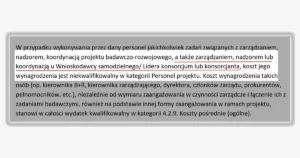
According to the Guidelines on control of the implementation of cohesion policy programmes for 2021–2027, institutions verify, among other things, the manner in which the project was implemented, the achievement of project indicators, the project’s compliance with the funding application and the grant agreement, the proper documentation of expenditure and, where the project is subject to sustainability requirements, compliance with those requirements.
The assessment therefore covers not only the expenditure itself, but also its connection with the particular project activity and its consistency with what the funding recipient declared at the application stage. The institution analyses the project as a whole, comparing the funding application, the grant agreement, payment applications, project documentation, correspondence and the way in which the project was actually implemented.
For funding recipients, problems most often arise when, after several years, it becomes difficult to reconstruct the course of the project or demonstrate the reasons for particular decisions. This applies especially to changes introduced during project implementation, discrepancies between the documentation and actual practice, and situations in which the project operated differently from what was originally described in the funding application. The passage of time does not in itself release the funding recipient from documentation obligations or those relating to project sustainability.
This is also clearly reflected in the case law of the administrative courts. The Supreme Administrative Court has emphasised that the funding recipient should be able to demonstrate that the funds were used for their intended purpose and in accordance with the applicable procedures. The problem may therefore concern not only the irregularity itself, but also the inability to carry out an effective control and verify the project after several years.
Can gaps or inconsistencies in the documentation still be effectively explained after a project control?
In practice, one of the most difficult moments in a project control arises when, only after the control activities have been completed, the funding recipient notices that part of the documentation is incomplete, inconsistent or does not accurately reflect the actual course of the project. This is often revealed by questions raised by the control team. It may concern, in particular, the reasons for decisions taken, the documentation of project modifications, the scope of work performed or the way in which expenditure was allocated to particular activities.
In such situations, the natural response is to try to organise the documentation or supplement missing elements. The difficulty, however, is that once the project control has been completed, the institution already has the material collected during the control activities and its own assessment of the project. Any new document, explanation or change in the description of the circumstances is therefore also assessed in terms of when it was created and whether it is consistent with the documentation already contained in the case file.
A particular risk arises where documents prepared after the project control are intended to substantiate circumstances that had not previously been documented in any way. This may concern, for example, attempts to reconstruct the scope of work performed by project staff, the rules governing cooperation with subcontractors, the method used to select contractors or the reasons for changes introduced to the project. The greater the discrepancy between the documentation existing during project implementation and documents created after the control, the greater the risk that their credibility will be challenged.
This does not mean that every inconsistency in the documentation automatically leads to a financial correction or repayment of funds. From the institution’s perspective, the key issue remains whether it is possible to establish the actual course of the project and whether the expenditure and activities complied with the funding conditions. If documentation is created only after the project control has been completed, it becomes very difficult to distinguish a genuine explanation of the project from a later attempt to adapt the documentation to the control findings.
Once the control activities have been completed, the possibilities for “correcting” the documentation are limited. The later the funding recipient attempts to reconstruct the course of the project or justify the way in which particular activities were carried out, the more important it becomes that the new explanations are consistent with the documentation and correspondence already contained in the project file.
A post-control report is more than just a summary of the project control
After the project control has been completed, the institution provides the funding recipient with a post-control report, to which the funding recipient may submit reasoned objections within 14 days of receipt. Many funding recipients treat the post-control report as a technical document that merely provides another opportunity to supplement missing information. In fact, it is often at this stage that the institution formally sets out for the first time its assessment of the way in which the project was implemented, the eligibility of expenditure and compliance with the funding conditions.
Problems arise when the response to the project control findings is prepared solely “from memory”, without analysing the earlier project documentation, correspondence and payment applications. Institutions compare the explanations submitted with the documents already contained in the project file. Any discrepancies between later explanations and earlier documentation therefore quickly become apparent.
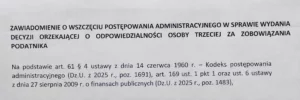
The legal nature of the post-control report itself is also important. It is not yet an administrative decision requiring repayment of funds. However, it very often determines the direction of the institution’s subsequent action, including possible financial corrections or repayment of funds, and failure to comply with the resulting demands may lead to administrative proceedings concerning repayment of funding.
Project control and repayment of funding become directly linked where the control findings lead the institution to challenge particular expenditure or the manner in which the project was implemented. The post-control report often determines how the matter develops further.
Project control and repayment of funding – from control findings to repayment proceedings
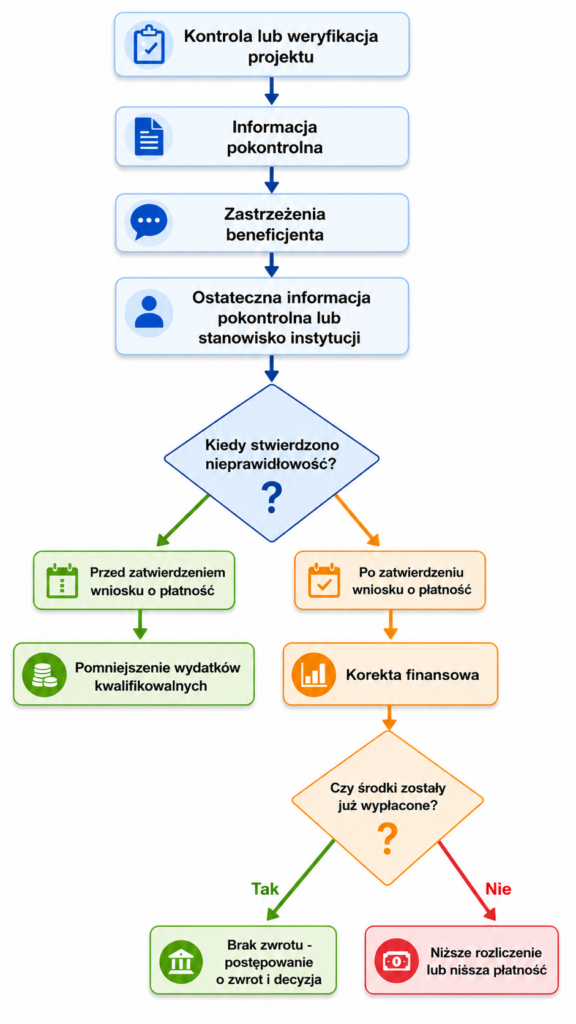
Control findings do not always lead to repayment of funding. Their significance depends on whether the institution identifies an irregularity and at what stage of the project settlement this occurs. I discuss what happens after expenditure is challenged in the article Can repayment of funding be avoided?
If an irregularity is identified before a payment application is approved, the consequence may be a reduction in the amount of eligible expenditure included in that application. If it is identified after the payment application has been approved, the institution may impose a financial correction. A further consequence may be an obligation to repay funds if the funding has already been paid.
From the funding recipient’s perspective, it is important that an irregularity does not necessarily involve obvious financial loss to the EU budget. Regulation (EU) 2021/1060 defines an irregularity broadly as an infringement of applicable law that has, or would have, the effect of prejudicing the Union budget by charging an unjustified item of expenditure to it. The institution must therefore examine in each case whether the infringement could have resulted in the financing of expenditure that should not have been regarded as eligible.
In practice, this means that following a project control, the dispute very often concerns the consequences of the identified breach — whether an irregularity actually occurred, which expenditure it concerns, whether it affects the eligibility of costs, whether it justifies a financial correction and whether funds already paid should be repaid.
The path from project control findings to repayment proceedings may be very short, although — importantly — not every project control results in a demand for repayment. What is decisive is whether the breach is classified as an irregularity, the stage of project settlement and the assessment of its impact on the eligibility of expenditure and the proper use of funds.
Project control and repayment of funding several years later
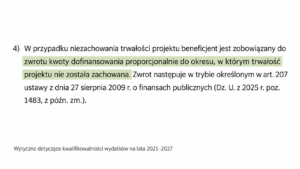
In practice, many funding recipients equate project settlement with the end of the risk of repayment of funding. However, the period during which a project may be subject to control is much longer than the project implementation period itself and may also include the sustainability period and the period for which project documentation must be retained.
Institutions most often return to projects years later when questions arise concerning compliance with project sustainability requirements, the achievement of project indicators, the use of project results or the eligibility of expenditure previously settled. A control may also be initiated as a result of findings made by other authorities, such as the Central Anti-Corruption Bureau (CBA), the Social Insurance Institution (ZUS), customs and tax authorities, as well as on the basis of cross-checks or information concerning organisational changes affecting the funding recipient.
From the funding recipient’s perspective, the difficulty is usually that the project is already operating in a completely different environment from that existing when the funding application was submitted. The organisational structure of the business, the staff responsible for the project, the way in which infrastructure is used or the business model may have changed. After several years, reconstructing the complete documentation and the reasons behind particular decisions also becomes more difficult.
The fact that an earlier project control raised no concerns does not prevent the institution from subsequently challenging expenditure or the manner in which the project was implemented if new circumstances or breaches are later identified within the applicable legal framework and control periods. An irregularity identified during a subsequent control may therefore lead to corrective action even where earlier controls found no breach.
Project control and repayment of funding – key takeaway
Project control and repayment of funding may remain linked even several years after the project has been formally settled. In such cases, it is important to be able to demonstrate that the project continues to meet the conditions under which the funding was awarded and that the course of its implementation can be reconstructed on the basis of the documentation.
Has a project control identified irregularities, or have you received a post-control report? See how the Law Firm supports funding recipients in matters concerning project controls and repayment of funding.