
An error in a procurement procedure does not always result in a financial correction.
When reviewing a procurement procedure, the funding institution may identify a breach of the applicable rules and link it to a financial correction. For the funding recipient, the key issues are then the content of the obligation alleged to have been breached, whether the conditions for an irregularity are met, and how the financial consequence has been determined.
This is well illustrated by a case concerning a contract notice. The funding recipient failed to include in the notice some of the information required under the Public Procurement Law then in force. That information was, however, included in the Terms of Reference (SIWZ) made available on the website. The dispute concerned the consequences of conducting the procurement procedure in this manner.
What error did the case concern?
The funding institution found that the contract notice did not contain information required under Article 41 points 7 and 7a of the Public Procurement Law then in force. This concerned the conditions for participation in the procedure, the grounds for exclusion of contractors, and the list of statements or documents required to demonstrate compliance with the conditions for participation and the absence of grounds for exclusion.
That information was included in the Terms of Reference (SIWZ) available on the website identified in the contract notice. However, the funding recipient did not include the required information in the notice itself or refer to the specific provisions of the Terms of Reference in which that information was set out.
What did the funding recipient argue?
The funding recipient argued that the deficiency was formal in nature and had caused no loss to the budget of the European Union. It referred to the structure of the EU standard form used for publication of the contract notice and to the availability of the complete procurement documentation on the website. It also argued that the failure to describe the conditions for participation in detail directly in the notice did not necessarily restrict competition. In its view, it could even have encouraged a broader group of contractors to take an interest in the procedure and review the procurement documentation.
The funding recipient also challenged the amount of the financial correction. It objected to the application of a 25% rate and argued that the lower rate applicable to the most closely corresponding category of irregularity should have been used.
What did the Supreme Administrative Court hold?
The Court agreed with the authority that the contract notice did not properly include the information required under Article 41 points 7 and 7a of the Public Procurement Law then in force. The funding recipient also failed to include a reference to the specific provisions of the Terms of Reference (SIWZ) dealing with those matters.
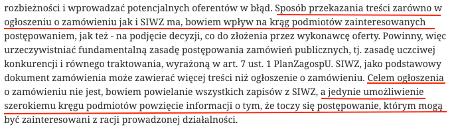
Providing the address of the website on which the Terms of Reference (SIWZ) had been made available was not considered sufficient to fulfil that obligation. The Court also noted that difficulties arising from the structure of the contract notice form did not prevent the required information from being included in the section intended for additional information.
At the same time, the Court emphasised that the contract notice and the Terms of Reference (SIWZ) perform different functions. The Terms of Reference may contain considerably more information, and the purpose of the notice is not to reproduce their entire content. The notice must, however, enable potential contractors to obtain sufficient information about the procedure to assess whether they are interested in participating. The manner in which information is provided may therefore affect the group of potential contractors and their decision whether to submit a tender.
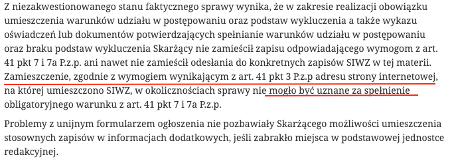
The Supreme Administrative Court also emphasised that the information contained in the contract notice is relevant to potential contractors because it may affect their decision whether to participate in the procedure. The Court held that the case involved a breach of procedures that could have had an impact on the budget of the European Union.
In this case, what mattered was therefore the potential impact of the manner in which the information was provided on contractors’ access to the procurement and on the competitiveness of the procedure.
When does a breach become an irregularity?
Establishing a breach of the public procurement rules is only one element of the assessment. The next step is to determine whether the breach meets the conditions for an irregularity capable of giving rise to financial consequences.
In this case, the Supreme Administrative Court referred to the definition of an irregularity laid down in Regulation No 1303/2013 and to the case law of the Court of Justice of the European Union. For an irregularity to be established, there must be a breach of law resulting from an act or omission by the funding recipient and an actual or potential prejudicial effect on the budget of the European Union.
The prejudice may be potential in nature and its precise amount does not have to be established. At the same time, the Supreme Administrative Court expressly indicated that the existence of such prejudice cannot be presumed solely from the fact that the law has been breached. It is necessary to demonstrate at least the possibility of a prejudicial effect on the EU budget.
In the case under discussion, however, an important procedural reservation applies. The Supreme Administrative Court did not reassess whether the defective content of the contract notice had in fact caused potential prejudice. The cassation appeal was based on allegations of substantive law infringements, whereas the finding of potential prejudice formed part of the factual findings adopted by the Voivodeship Administrative Court. The funding recipient did not challenge those findings by raising the relevant procedural allegations, and the Supreme Administrative Court was therefore bound by them.
How is the amount of a financial correction determined?
Once an irregularity has been established, the next issue is its financial consequence. The amount of the correction depends on the type of irregularity, the expenditure concerned and the rules applicable to the particular project.
For projects implemented under the 2014–2020 financial perspective, the rules for reducing financial corrections relating to public procurement were laid down in the Regulation on the conditions for reducing financial corrections and expenditure incurred irregularly. The annex to that regulation specified percentage rates corresponding to particular categories of irregularities, commonly referred to as the “financial correction tariff”.
Where the amount of expenditure incurred irregularly could be identified precisely, the financial correction was calculated by reference to that amount. Where the effects were indirect or difficult to quantify, or where the irregularity could have discouraged potential contractors from participating in the procedure, the regulation provided for the application of an appropriate percentage rate. The assessment took into account the nature and seriousness of the irregularity, in particular the extent to which the principles of fair competition, equal treatment of contractors, transparency and non-discrimination had been breached.
The amount of the financial correction was also disputed in the case under discussion. The authority applied a 25% rate under item 9A of the financial correction tariff. The funding recipient, however, relied on a provision allowing the application of the rate corresponding to the most closely related category of irregularity and argued that a 5% rate should apply. The Supreme Administrative Court rejected that argument, noting that, while alleging that § 6 of the regulation on financial corrections had not been applied, the appellant had not challenged the authority’s application of item 9A of the tariff or the specific type of individual irregularity identified there and established in the facts of the case.
How does this apply to projects under the 2021–2027 financial perspective?
Currently, the method for correcting irregularities is governed by the Guidelines on the correction of irregularities. The annex to the Guidelines contains the current financial correction tariff, setting out the rates of corrections and reductions applicable to irregularities relating to procurement.
What errors in a procurement procedure may lead to a financial correction?
When assessing a procurement procedure, funding institutions examine how the contractor was selected and whether potential contractors had equal access to information and an equal opportunity to compete for the contract.
The risk of a financial correction may therefore arise, for example, where:
- the required information was not properly published,
- the deadline for submitting tenders was shortened in a manner that restricted contractors’ ability to participate,
- following a material change to the procurement documentation, contractors were not given sufficient time to prepare their tenders,
- conditions for participation or technical requirements restricted contractors’ access to the contract,
- the description of the subject matter of the contract referred to a specific product or solution in a manner restricting competition.
In each of these situations, what matters is the impact of the deficiency on competition and on contractors’ access to the contract.
Classifying an event under one of these categories requires reference to the particular procurement procedure. Relevant factors include the content of the procurement documentation, the requirements applicable at the time and the actual or potential impact of the deficiency on competition and on the project budget.
What should be checked after receiving information about a financial correction?
After receiving a post-control report, the first step is to determine which specific obligation the institution considers to have been breached and from which provision, guideline or term of the funding agreement it derives that obligation. The version of the documents applicable when the particular procurement procedure was conducted is also relevant.
The next step is to compare the allegation with the procurement documentation itself and determine whether the facts described by the institution actually reflect what occurred during the procedure.
Another issue is whether the breach has been correctly classified as an irregularity. This requires examining how the institution linked the identified deficiency to actual or potential prejudice to the budget of the European Union.
The amount of the financial consequence also requires separate verification: the applicable item of the financial correction tariff, the percentage rate and the value of the expenditure used as the basis for calculating the correction or reduction. If the matter subsequently proceeds to proceedings concerning repayment of funding, the correctness of those findings may still be subject to review.
Have you received a post-control report in which the funding institution identified an error in a procurement procedure or imposed a financial correction? See how the Law Firm supports funding recipients in matters concerning public funding under: Services – project controls and repayment of funding.