
The final payment and project sustainability are directly linked, as the date of the final payment usually marks the beginning of the sustainability period. Receipt of the final payment closes the project settlement stage, but it does not mean that all of the funding recipient’s obligations have come to an end. A project is usually required to maintain sustainability for the following years, during which the funding institution may verify whether the sustainability requirements continue to be met. Importantly, the Project Control Guidelines provide for a separate control of project sustainability.
Final payment and project sustainability – how long does the sustainability period last?
The principal provision governing project sustainability is Article 65 of Regulation (EU) 2021/1060 of the European Parliament and of the Council.
For projects involving investment in infrastructure or productive investment, the sustainability period is generally five years from the date of the final payment to the funding recipient. In the case of SMEs, this period may be reduced to three years in relation to maintaining the investment or jobs, where permitted by the applicable rules.
The date of the final payment therefore has significance beyond the settlement of the final payment application itself. It also marks the beginning of the period during which the funding institution may verify whether the project sustainability requirements are being met.
What is a project sustainability control?
The Guidelines on controls of cohesion policy programmes for 2021–2027 provide for a sustainability control as a separate type of control carried out after completion of project implementation.
Its primary purpose is to verify whether, in relation to the co-financed investment, any of the circumstances referred to in Article 65 of the Common Provisions Regulation has occurred. In particular, this involves assessing whether the conditions on which the project received funding have been maintained during the sustainability period.
For the funding recipient, it is therefore important to distinguish between two stages. Completion of project implementation and settlement of the final payment mark the end of the implementation stage. The sustainability period constitutes a subsequent stage in the performance of obligations arising from the funding received.
What can the funding institution verify during a sustainability control?
The scope of a sustainability control may be broader than merely establishing whether the investment is still operational. Under the Guidelines, the control may also cover other matters subject to verification after completion of project implementation. The institution may examine, among other things:
- whether double funding has occurred, including as a result of a change in VAT eligibility,
- whether the project objective has been maintained through the achievement and maintenance of result indicators,
- whether project documentation has been properly retained,
- whether information and publicity obligations have been complied with,
- whether the rules on State aid have been complied with.
In practice, this means that approval of the final payment application does not yet mean that all matters relating to the project have been closed. Some obligations are, by their nature, verified only in the following years.
What does a project control after completion look like?
A sustainability control may be carried out at the place where the project was implemented or at the premises of the entity being controlled. The Guidelines also allow such controls to be carried out on a sample basis.
Sustainability controls are also carried out using the e-Kontrole application. From the funding recipient’s perspective, project documentation becomes particularly important during this period. The institution may revisit circumstances relating to the implementation of the investment several years after the final funds were paid, which means that both documents created during project implementation and documentation concerning the project’s subsequent operation may be relevant.
This is particularly relevant to investment projects where, after completion, there is a change in the way the infrastructure is used, the organisational structure of the company, or the manner in which the activity supported by the funding is carried out.
What happens in practice after the final payment?
During the period following project completion, the funding recipient will often:
- reorganises the structure of the business or corporate group,
- changes the way in which the project results are used,
- relocates activities to another location,
- introduces efficiency-driven changes that were not assessed at the project selection stage,
- carries out a transformation, division or sale of the business.
Such actions are usually justified from a business perspective, but from the perspective of project sustainability they may be challenged if they affect the scope of operations, indicators or conditions on which the funding was awarded. The risk arises in particular where a decision is implemented without first determining whether the funding agreement and project documentation require the institution to be notified, its consent to be obtained or the agreement to be amended.
What if a control identifies a breach of project sustainability?
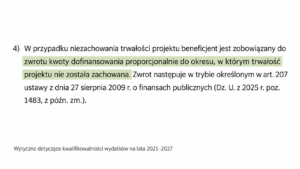
If, during a control, the institution identifies circumstances indicating a breach of the sustainability requirements, financial consequences may arise. The Guidelines provide that a financial correction related to a breach of the sustainability principle should be proportionate to the period during which the sustainability requirements were not met.
Determining whether a particular change actually constitutes a breach of project sustainability requires a separate assessment. Relevant factors include the type of project, the funding recipient’s obligations, the nature of the change and its impact on the project’s objectives and conditions.
I discuss in more detail when a change may be regarded as a breach of project sustainability and what consequences it may have for the funding in the article Breach of project sustainability – does the entire grant have to be repaid?
Can a control take place after the sustainability period has ended?
A sustainability control is carried out during the period in which the funding recipient remains bound by the obligation to maintain project sustainability. However, the Guidelines also provide for the possibility of conducting controls after the sustainability period has ended.
Under Chapter 8, point 8 of the Guidelines, after the sustainability period has ended, the managing authority may continue to carry out controls to verify the project’s compliance with EU and national law. This is a separate legal basis for control, and its subject matter and limits differ from those of a project sustainability control under Article 65 of the Common Provisions Regulation.
This is also of practical importance for the obligation to retain project documentation. The expiry of the sustainability period does not, in itself, mean that all documentation-related obligations have ended or that the project can no longer be subject to subsequent verification. The scope of those obligations must be determined taking into account the applicable provisions, the funding agreement and the programme documentation.
What should be checked after receiving the final payment?
After project implementation has been completed, it is worth determining first of all when the sustainability period begins, which obligations remain in force and which documents may be required in the event of a subsequent control.
In investment projects, particular attention should also be paid to changes planned after project completion. If they concern the use of the investment, the location of the business, the company’s structure or the project results, they should be assessed against the conditions arising from the funding agreement and the project documentation before they are implemented.
Key conclusion
The final payment closes the financial stage of project implementation. In projects subject to sustainability requirements, it also marks the beginning of a period during which the funding institution may verify whether the investment and its results are maintained in accordance with the conditions on which the funding was awarded.
A sustainability control has its own legal basis and scope. It may cover both circumstances directly related to Article 65 of the Common Provisions Regulation and other obligations that remain in force after project implementation has been completed, including the maintenance of the project objective and results, project documentation, State aid rules and information obligations.
After receiving the final payment, the funding recipient enters a stage in which some project-related obligations continue even though ongoing implementation and settlement of expenditure have ended. During this period, decisions concerning the use of the investment, organisational and ownership changes, location and the maintenance of project results become particularly important. Assessing such changes before they are implemented makes it possible to determine whether they remain consistent with the funding conditions and whether any action towards the funding institution is required.
Is the funding institution questioning how the project was implemented after its completion?
See how the Law Firm supports funding recipients in matters concerning project sustainability, project controls and repayment of funding: Services – project controls and repayment of funding.