
Ineligible expenditure may result in a reduction of funding, a financial correction or repayment of funds if they have already been disbursed. The mere fact that a cost was included in the application for funding, incurred and supported by an invoice does not in itself determine its eligibility.
In practice, the issue often becomes apparent only when a payment application is being verified or during a project control. The funding institution may then examine how the cost was incurred, its connection with the project, the supporting documentation, the procedure used to select the contractor, and compliance with procurement rules or the terms of the funding agreement.
For the funding recipient, the key is to determine why the particular item of expenditure has been challenged and at what stage of project implementation and settlement the matter has arisen. Both the potential financial consequence and the appropriate further procedure depend on this.
When is expenditure eligible?
For projects implemented under the 2021–2027 financial perspective, the basic point of reference is the Guidelines on the eligibility of expenditure. The current version has applied since 25 May 2026 and sets out common eligibility conditions and procedures for projects supported, among others, by the ERDF, ESF+, the Cohesion Fund and the JTF.
Assessment of expenditure involves several elements at the same time. Relevant factors include its compliance with the law, the funding agreement and the applicable programme documentation, whether the cost was actually incurred, its connection with project implementation, its necessity, reasonableness and efficiency, and whether it was properly documented. Official materials concerning the application of the Guidelines also refer to the requirement that expenditure be incurred transparently and in accordance with the principle of obtaining the best results from the resources used. The eligibility of a cost therefore depends on the overall manner in which it was incurred and used in the project. Its inclusion in the approved budget is only one element of that assessment.
The expenditure was approved in the application for funding. Why can a problem arise later?
At the project selection stage, the funding institution assesses the planned activities, budget, schedule and expected results. Only during project implementation can it be verified how a particular purchase was actually made and used.
For example, a particular item of equipment may have been included in the application for funding, but issues may arise during its purchase concerning:
- the procedure used to select the contractor,
- compliance with the principle of competitiveness,
- links between the entities involved,
- whether the specifications of the equipment purchased are consistent with the project,
- the price and its reasonableness,
- the use of the equipment for project activities,
- the date on which the cost was incurred,
- documents confirming that the goods were delivered or the service was performed.
Ineligible expenditure may therefore result both from the nature of the cost itself and from the manner in which the funding recipient made the purchase or accounted for it.
This is particularly important in R&D projects. Technical needs may change as successive stages of research progress. When expenditure is assessed several years later, documents showing why a particular purchase was necessary and how it related to the planned work may therefore be particularly important.
Why are an invoice and proof of payment not enough?
An invoice and proof of payment show that expenditure was incurred. They do not always demonstrate that it was eligible. When settling publicly funded projects, the process leading to the purchase also matters. The funding institution may examine, among other things, how the contractor was selected, compliance with the competitiveness principle, any links with subcontractors, conflicts of interest, the reasonableness of the expenditure, and its consistency with the scope of the project.
The invoice usually appears only at the end of that process. It does not explain who made the purchasing decision, why a particular solution was selected, whether available alternatives were compared, whether the required procedures were followed, or which element of the project required the purchase.
If the underlying issue arose earlier, the invoice and proof of payment will usually not resolve it. This is particularly important in larger projects and R&D projects. Purchasing decisions are made in stages, the individuals responsible for particular tasks may change, and some activities result from evolving technical or research needs. Several years later, the accounting document alone may not be sufficient to reconstruct why a particular solution was necessary and how it contributed to achieving the project results.
What happens when expenditure is challenged before the funding is disbursed?
Information that expenditure has been considered ineligible should not be treated solely as a problem concerning the invoice. For projects under the 2021–2027 financial perspective, Article 26(8) of the Implementation Act distinguishes between two situations. If an individual irregularity is identified before a payment application is approved, the funding institution reduces the amount of eligible expenditure included in the application by the amount of expenditure incurred irregularly. If the irregularity is identified after the payment application has been approved, the competent institution imposes a financial correction.
This distinction is important in practice.
If the funding recipient submits expenditure for reimbursement and the institution refuses to recognise it as eligible, the dispute may concern an amount that has not yet been paid. The situation is different where the expenditure was previously accepted and funded, and the problem only emerges during a subsequent project control. In the first case, the business may receive less funding than anticipated in its financial schedule. In the second, there is a risk of recovery of funds that have already been disbursed.
Ineligible expenditure after funding has been disbursed
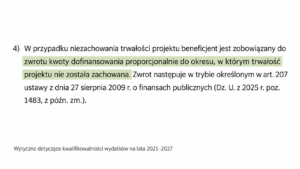
If the funds have already been disbursed, it is necessary to determine the legal basis for their recovery. For programmes financed with European funds, Article 207 of the Public Finance Act may be of fundamental importance. It applies to funds used contrary to their intended purpose, used in breach of the applicable procedures, or received unduly or in an excessive amount. If one of the statutory conditions is met, the funding recipient may be required to repay the funds together with interest.
The funding institution’s use of the term “ineligible expenditure” is not sufficient in itself. It is still necessary to determine which obligation is alleged to have been breached, which event the institution considers irregular and how it links that event to a particular amount of funding. This distinction becomes particularly important where the institution challenges only part of the project but attaches a financial consequence to a broader group of expenditure.
Does every item of ineligible expenditure mean that funding must be repaid?
Not always. The extent of the financial consequences should follow from the nature of the identified problem and the rules applicable to the particular project. If the objections concern a specific cost, the first question is which expenditure is connected with the alleged breach. The assessment will be different where a single invoice is challenged and where the institution considers that the problem concerns the manner in which an entire task was carried out or the achievement of the project objective.
For the 2021–2027 financial perspective, the Implementation Act provides that the amount of a financial correction resulting from an individual irregularity corresponds to the amount of expenditure incurred irregularly in the part attributable to EU funding.
The most important step is to establish precisely what the funding institution’s position is based on. Without that, it is difficult to determine whether the issue concerns a formal deficiency, a dispute over the interpretation of the funding agreement, a procurement procedure, or a more serious risk of repayment of funding.
Why is it worth acting early?
Many problems concerning the eligibility of expenditure only come to light during a project control, although their source arises much earlier — when planning a purchase, modifying the scope of the project, selecting a contractor, describing expenditure in a payment application, or responding to questions from the funding institution.
Ongoing legal support for a project therefore involves more than responding once a project control begins or a demand for repayment of funding is received. It is most valuable when there is still time to organise the documentation, explain a project modification, and reduce the risk of a dispute with the funding institution.
The version of the documents applicable to the particular expenditure matters
In projects implemented over several years, one further issue should be taken into account. Guidelines, programme rules, funding agreements and other project documents may change during project implementation. The current Guidelines on the eligibility of expenditure for the 2021–2027 financial perspective have applied since 25 May 2026, while earlier versions of those documents are also available on the European Funds Portal.
The assessment of expenditure should therefore take into account the documentation applicable to the particular project and at the relevant time. Where a project control is carried out several years after the cost was incurred, referring only to the version of a document currently available may not be sufficient.
For this reason, in a dispute concerning the eligibility of expenditure, the chronology of the applicable documents may be just as important as the invoice itself.
Ineligible expenditure – where should the assessment begin?
After receiving information that a cost has been challenged, it is worth gathering four groups of documents:
- documents defining the obligation – the funding agreement, application for funding, applicable guidelines, programme rules and programme documentation;
- documents relating to the expenditure incurred – the procurement procedure, contract with the contractor, invoice, payment and acceptance documentation;
- documents showing the connection between the cost and the project – reports, technical documentation, correspondence, minutes and materials relating to performance of the task;
- correspondence with the funding institution – in particular earlier approvals, information on project modifications, approved payment applications and project control documents.
Only after these elements have been considered together is it possible to assess whether the ineligible expenditure actually results in a reduction of funding or repayment of funds and what amount may be affected by such a demand.
Has the funding institution challenged expenditure, imposed a financial correction or demanded repayment of funds? The Law Firm’s scope of support in such matters is described under Project controls and repayment of funding.